
Heavy-Traffic Boards for Ramps and Loading Areas
A ramp, a loading bay and a temporary access platform all ask the same thing of a board: hold a footing under traffic, in weather, for the length of the project. The anti-slip range published by Dongstar Wood — Anti-slip Film Faced plywood in the client's own naming — answers with a textured hexagonal phenolic film, thicknesses from 9 mm to 21 mm, and WBP adhesive options bonded into the panel.

Key takeaways
- The range is published as Wire Mesh Film Faced Plywood, or Anti-Slip Film Faced Plywood in the client's own naming.
- Thickness spans 9 mm to 21 mm across different load requirements; 1220 × 2440 mm is the standard size.
- A raised hexagonal pattern in the phenolic face gives the grip underfoot, and the boards come with one or both faces textured depending on the duty, so the surface choice is written into the specification before the order is placed.
- Adhesives include WBP (Phenolic), Melamine, or E1/E0; sealed edges protect the core on site.
Where heavy-traffic boards work
The application list on the page reads like a site plan: scaffolding boards with slip resistance, walkboards for roofing work, temporary flooring, platforms for safe access, bridge deck construction, formwork for industrial concrete slabs. The common thread is traffic — foot traffic, trolley traffic, vehicle traffic — crossing a surface that must not slide, and must not fail, for as long as the structure underneath is built.
Ramps and loading areas are the hardest members of that list. A ramp combines slope, traffic and weather: a board that is merely flat is not enough when a loaded trolley crosses it in the rain. The anti-slip surface is specified for exactly this combination, and the thickness is chosen for the load that crosses it.
The surface that grips
The grip comes from the surface texture. The page describes a textured hexagonal wire-mesh phenolic film — a raised pattern that gives boots and tyres something to bite into, wet or dry. The film is phenolic, so it resists the alkaline exposure of fresh concrete and the wear of repeated traffic; the smooth reverse comes with the single-sided option, and the double-sided option textures both faces.
The single-sided option exists for a reason: a walkboard laid over a scaffold only needs the grip face up, and the smooth reverse sits cleanly on the scaffold boards. A temporary floor that will be walked on from both sides, or a platform that gets flipped in service, takes the double-sided option. The choice is written into the specification, not left to the delivery.
Thickness across the 9–21 mm range
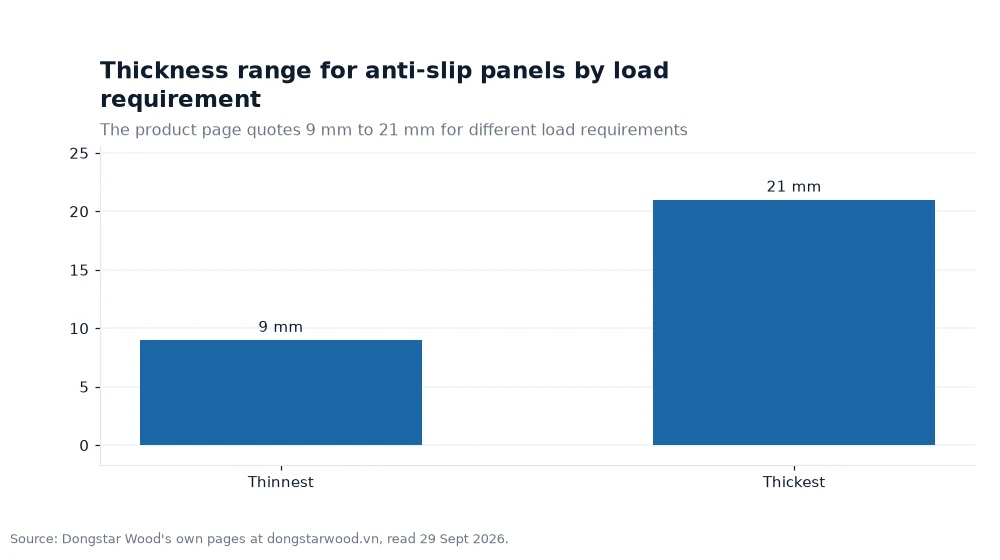
The published thickness range runs 9 mm to 21 mm for different load requirements. The span is a load ladder: lighter foot traffic on a solid substructure takes the thin end; vehicle ramps, loading platforms and bridge deck work take the thick end. The standard size is 1220 × 2440 mm, with 1250 × 2500 mm and 1500 × 3000 mm also published and custom panels up to 1830 × 3830 mm.
The thickness choice is a span-and-load calculation. A board that spans between scaffold standards deflects under a point load — a trolley wheel, a pallet corner — and the deflection is what the extra millimetres buy back. Where the span is short and the substructure solid, 9 mm or 12 mm serves; where the span opens up or the load wheels in, 18 mm and 21 mm hold the plane.
Adhesives and exposure
The adhesive options are WBP (Phenolic), Melamine, or E1/E0. For boards that will see weather, concrete and temperature swing on site, the WBP phenolic option is the one that keeps the layers bonded through repeated wetting and drying — the same chemistry that serves the formwork range, specified here for the exposure a walkboard actually meets.
The page also names sealed edges as part of the product. The edges are where water enters a panel, and a board that lives outdoors for a season takes its moisture there; sealed edges keep the core dry and the layers bonded, which is what lets the board be reused across the project rather than consumed by it.
Maintenance and reuse
Multiple reuse cycles are claimed on the page with proper edge and surface maintenance, and the claim is conditional in an important way. A board that is cleaned, stacked flat and stored under cover outlasts one left on a muddy deck; a board whose sealed edges are inspected and touched up outlasts one with a wicking edge. The reuse is earned on site, not delivered with the panel, and the maintenance routine is as much a part of the specification as the thickness or the adhesive choice.
The same maintenance logic covers the grip surface. A film face caked with dried concrete loses its texture, and a lost texture is a lost safety feature. A board washed down between pours keeps its hexagonal pattern — and keeps the footing it was specified to provide. For projects that run across seasons, the sealed edges are the first thing to check at the start of each phase, because moisture ingress through an unsealed edge is the fastest route to delamination.
| Application | Thickness | Surface | Adhesive |
|---|---|---|---|
| Scaffolding boards, access platforms | 9–15 mm | Hexagonal, single-sided | WBP (Phenolic) |
| Roofing walkboards, temporary flooring | 12–18 mm | Hexagonal, single or double | WBP (Phenolic) |
| Ramps, loading areas | 18–21 mm | Hexagonal, double-sided | WBP (Phenolic) |
| Bridge deck construction | 21 mm | Hexagonal, double-sided | WBP (Phenolic) |
Worked example: ramp coverage
Twelve 1220 × 2440 mm sheets deliver 2.9768 m² per sheet, yielding 12 × 2.9768 = 35.7216 m² of walkable surface in total. The thickness range of 9 mm to 21 mm — a 12 mm spread — defines the load capacity: the thin end carries foot traffic on a solid base, while the thick end bears vehicles on a ramp.
The reuse arithmetic follows the same pattern as the formwork range. A board that survives ten cycles on a scaffold has delivered 10 × 2.9768 = 29.768 m² of safe access per sheet; one that survives twenty has delivered 59.536 m². The difference is the maintenance budget — cleaning, edge care and storage — written into the site plan.
Frequently asked questions
What is the difference between the wire mesh and ordinary black ranges?
The wire mesh range carries a textured hexagonal phenolic film for grip, while the ordinary black range carries a smooth black film for standard pours. The anti-slip surface is the safety feature; the smooth surface is the economical formwork finish.
Which thickness should a loading ramp be?
The published range runs 9 mm to 21 mm for different load requirements. Ramps and loading areas take the thick end — 18 mm to 21 mm — because the span and the point loads of trolleys and vehicles are what the extra millimetres absorb.
Can the boards be reused?
Yes, with proper edge and surface maintenance. The page claims multiple reuse cycles, and the condition is site practice: clean the film face, protect the sealed edges, stack the boards flat and under cover between uses.
From access platform to finished floor
With the surface, thickness and adhesive specified, the temporary works are covered. For the permanent finishes that follow, the ordinary black range covers the standard formwork pours, and the film faced category covers the heavy formwork that comes next. One supplier, one specification habit, whole project.
Statistics quoted above were sourced from the supplier's published pages read 29 Sept 2026[1].