
Yuh Siang Garden · Bukit Timah · Est. 1972 Field Notes from the Curators
Can a dental zirconia block improve accuracy in digital dentistry workflows?
Volume Default
Date
In the digital dental process, a high-quality dental zirconia block is the cornerstone for improving the precision of the final restoration. Its outstanding dimensional stability is the key to achieving micron-level fitting. For instance, a standard 98mm x 25mm zirconia block, after being sintered at 1450 degrees Celsius, has its linear shrinkage rate precisely controlled within the range of 20%±0.5%, and this shrinkage is highly predictable and isotropic. This means that the CAD software can perform 20% magnification compensation in advance. The gap between the edge of the final sintered tooth crown and the preparation can be stably controlled between 20 and 40 microns, which is far lower than the clinically acceptable standard of 100 microns, achieving almost perfect passive positioning.
From the perspective of the integrity of the data chain, the integration of high-quality zirconia blocks with digital processes eliminates errors in information transmission. In traditional lost-wax casting, each step may introduce an error accumulation of 50 to 100 micrometers. By obtaining data through in-mouth scanning and directly cutting zirconia blocks with a strictly calibrated five-axis milling machine, the overall error of the entire process can be reduced to less than 25 microns. In a comparative study conducted by the Dental Center of the University of Zurich in 2021, it was confirmed that the clinical excellence rate of edge fit of restorations fabricated using a digital all-zirconia process was as high as 98.5%, while that of the traditional method group was only 85%.
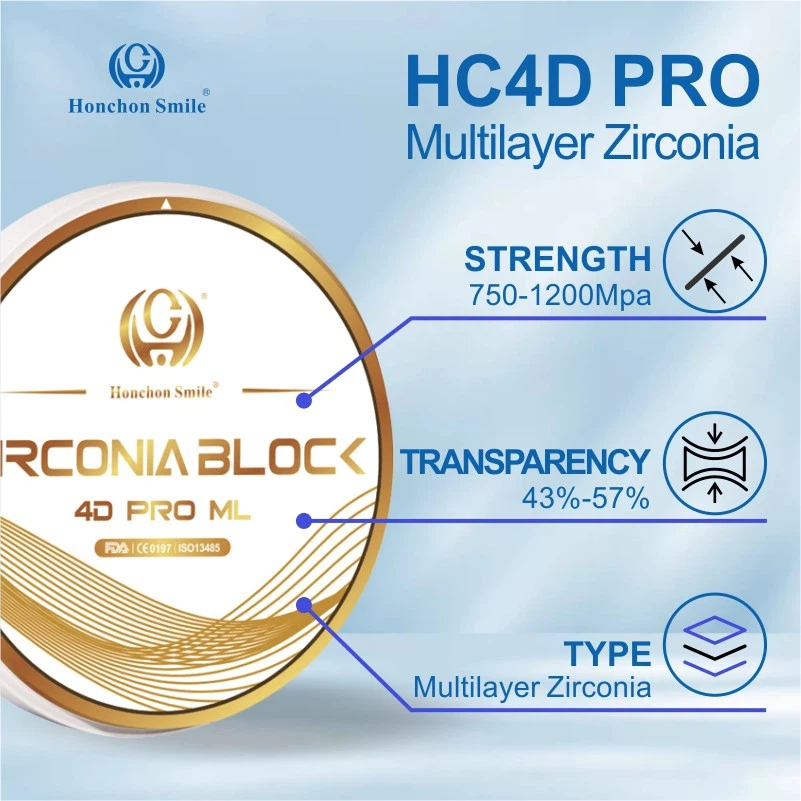 The machinability of materials is another core factor affecting accuracy. Pre-sintered zirconia blocks have uniform density and moderate hardness, with a Brinell hardness of approximately 250 HB. This enables the 0.6mm diameter cutter of a milling machine to perform high-precision cutting at a feed rate of 2000 mm per minute without excessive tool wear or material chipping. An analysis of the production efficiency of a dental workshop shows that by using high-quality zirconia blocks, the average lifespan of a single precision tool can be extended to 120 tooth units, reducing the probability of dimensional deviation of restorations caused by tool wear from 8% to less than 1%.
The inherent thermal stability of zirconia material provides tolerance for the entire process flow, further ensuring accuracy. Even after cutting, the crystal structure transformation of the restoration is controllable and uniform during the sintering process at up to 1500 degrees Celsius, ensuring that the restoration does not distort or deform. According to a study published in the Journal of Dental Materials, the dimensional consistency standard deviation of 100 dental crowns made from the same batch of zirconia blocks after sintering was less than 15 micrometers. This high degree of repeatability makes it possible for large-scale batch production to achieve a qualification rate of over 99%, completely changing the manufacturing standards of restorations.
The machinability of materials is another core factor affecting accuracy. Pre-sintered zirconia blocks have uniform density and moderate hardness, with a Brinell hardness of approximately 250 HB. This enables the 0.6mm diameter cutter of a milling machine to perform high-precision cutting at a feed rate of 2000 mm per minute without excessive tool wear or material chipping. An analysis of the production efficiency of a dental workshop shows that by using high-quality zirconia blocks, the average lifespan of a single precision tool can be extended to 120 tooth units, reducing the probability of dimensional deviation of restorations caused by tool wear from 8% to less than 1%.
The inherent thermal stability of zirconia material provides tolerance for the entire process flow, further ensuring accuracy. Even after cutting, the crystal structure transformation of the restoration is controllable and uniform during the sintering process at up to 1500 degrees Celsius, ensuring that the restoration does not distort or deform. According to a study published in the Journal of Dental Materials, the dimensional consistency standard deviation of 100 dental crowns made from the same batch of zirconia blocks after sintering was less than 15 micrometers. This high degree of repeatability makes it possible for large-scale batch production to achieve a qualification rate of over 99%, completely changing the manufacturing standards of restorations.
The machinability of materials is another core factor affecting accuracy. Pre-sintered zirconia blocks have uniform density and moderate hardness, with a Brinell hardness of approximately 250 HB. This enables the 0.6mm diameter cutter of a milling machine to perform high-precision cutting at a feed rate of 2000 mm per minute without excessive tool wear or material chipping. An analysis of the production efficiency of a dental workshop shows that by using high-quality zirconia blocks, the average lifespan of a single precision tool can be extended to 120 tooth units, reducing the probability of dimensional deviation of restorations caused by tool wear from 8% to less than 1%.
The inherent thermal stability of zirconia material provides tolerance for the entire process flow, further ensuring accuracy. Even after cutting, the crystal structure transformation of the restoration is controllable and uniform during the sintering process at up to 1500 degrees Celsius, ensuring that the restoration does not distort or deform. According to a study published in the Journal of Dental Materials, the dimensional consistency standard deviation of 100 dental crowns made from the same batch of zirconia blocks after sintering was less than 15 micrometers. This high degree of repeatability makes it possible for large-scale batch production to achieve a qualification rate of over 99%, completely changing the manufacturing standards of restorations.Plan a visit
The garden is open Tuesday through Sunday. Visitor numbers are capped to protect the collections.
Reserve your timed entry in advance. Members of the Heritage Trust enjoy unlimited weekday access and a printed quarterly Living Index.